Japan's Inflation and Yen Weakness: Bank of Japan Policy Challenges
Emile Bartow
February 16, 2026
Japan's Inflation and Yen Weakness: BoJ Policy Challenges
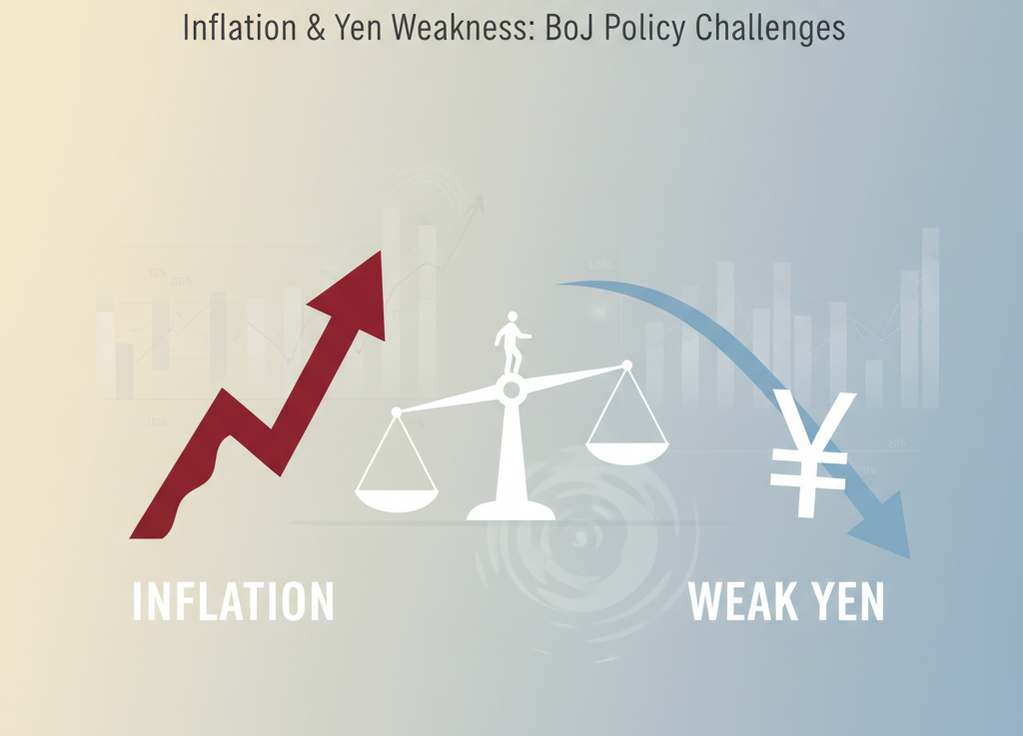
Japan is facing an economic conundrum: rising inflation coupled with a persistently weak yen. This dual challenge is putting pressure on the Bank of Japan (BoJ) to navigate its monetary policy deftly. The world is watching as the BoJ contemplates rate hikes while grappling with the implications of a depreciating currency.
Key Takeaways
- Japan's inflation rate is projected to rise significantly, influenced by a weak yen and global economic factors.
- The BoJ faces increased pressure to raise interest rates, with markets anticipating an 80% chance of a hike by April.
- The depreciation of the yen is contributing to higher import costs, exacerbating inflationary pressures in the economy.
- Analysts predict that the BoJ's current policies may limit its flexibility to respond to inflation effectively.
- A miscalculated policy response could risk stalling Japan's economic recovery following years of stagnation.
- The interplay between fiscal and monetary policy is crucial for Japan to stabilize its economy amidst these challenges.
- Public sentiment around inflation is shifting, with consumers increasingly concerned about rising living costs.
Rising Inflation: The Current Landscape
Japan’s inflation rate is on a trajectory that could see it breach the BoJ's target of 2%. Recent reports indicate inflation could accelerate further due to the rising costs of raw materials and energy, both significantly impacted by the weak yen. As the currency loses value, imported goods become pricier, which translates to higher prices for consumers. This is a stark contrast to Japan's long-standing battle against deflation, a challenge that has persisted for over two decades.
The situation has led to a market consensus that the BoJ may need to adjust its stance. Former BoJ official Takahide Kiuchi pointed out that if inflation remains above the target for some time, the central bank might have no choice but to reconsider its ultra-loose monetary policy.
The Yen's Plunge: Causes and Consequences
The yen's depreciation is not merely a consequence of domestic policy but also a reflection of global economic dynamics. As central banks around the world, particularly the U.S. Federal Reserve, tighten their monetary policies, the yen has weakened in comparison. This depreciation is problematic, as it fuels inflation—a scenario that the BoJ has sought to avoid.
The currency's weakness is also influencing consumer sentiment. Japanese households are starting to feel the pinch, with many reporting increased anxiety over rising prices. According to a recent survey, almost 60% of consumers express concern about their purchasing power, a sentiment that could shape economic behavior if it persists.
BoJ’s Policy Dilemma: Rate Hikes on the Horizon?
With inflationary pressures intensifying, the BoJ faces a critical decision: should it raise interest rates? The market is betting on an 80% chance of a rate hike by April, a move that would mark a significant departure from the bank’s long-held stance of keeping rates low to stimulate growth. However, the BoJ must tread carefully.
Raising rates could stifle economic growth, particularly in a country still recovering from the pandemic's impacts. If the BoJ missteps, it could derail the recovery, pushing Japan back into the quagmire of stagnation.
Makbule Deniz, an economist at a leading financial institution, remarked, “The BoJ’s room for maneuver in monetary policy is narrowing. It’s a tightrope walk that needs to account for both inflation and growth.”
The Fiscal-Monetary Policy Nexus
The intersection of fiscal and monetary policy is crucial for Japan at this juncture. The government has been ramping up spending to support the economy, but rising inflation complicates this approach. Increased fiscal spending might further inflate prices, leaving the BoJ with fewer options.
The challenge lies in coordinating efforts between the government and the BoJ. If fiscal policies are not aligned with monetary strategies, the result could be a counterproductive cycle of inflation and stagnation. The Japanese government needs to consider long-term investments that bolster productivity while the BoJ must focus on stabilizing prices without curtailing growth.
A Crossroads for Japan's Economy
Japan is at a crossroads. The dual challenges of inflation and yen weakness present a significant test for the BoJ. As the central bank weighs its options, it must consider not just immediate pressures but also the long-term health of the economy. The outcome of this delicate balancing act will have profound implications for Japan’s economic landscape.
In this era of uncertainty, consumers and businesses alike are left to navigate the shifting terrain. As Japan moves forward, it must confront these challenges head-on, lest it fall back into the cycle of stagnation that has long plagued its economy. The decisions made in the coming months will be pivotal, not just for Japan, but for global markets watching closely.