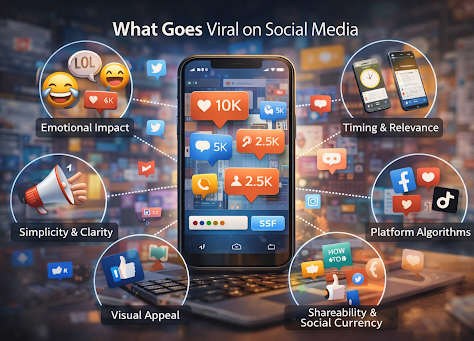
7 Factors That Decide What Goes Viral on Social Media
Lilla Odin
April 28, 2026
Every day, millions of posts are published across social media platforms. Most of them disappear quietly into the feed. A few gain moderate attention. And then there are the rare ones that explode across timelines, earning thousands or even millions of shares, comments, and reactions.
Going viral may look random, but it rarely is. Behind viral content are patterns, psychological triggers, and strategic elements that dramatically increase the chances of widespread sharing. While no formula guarantees success, understanding these seven factors can help explain why some posts take off while others fade away.
Emotional Impact
Emotion is one of the strongest drivers of virality. Content that makes people feel something intensely is far more likely to be shared.
Positive emotions such as joy, inspiration, and awe often lead users to pass content along to others. At the same time, high-arousal emotions like anger, surprise, or outrage can also fuel rapid sharing. When a post sparks a strong reaction, people feel compelled to respond or show it to their network.
Content that triggers emotional resonance creates a sense of connection. It moves beyond information and becomes an experience worth spreading.
Relatability
People share content that reflects their own experiences, struggles, humor, or aspirations. When someone sees a post and thinks, “This is so me,” they are much more likely to share it.
Relatable content works because it validates personal identity. It makes users feel seen and understood. Memes, everyday life observations, and honest storytelling often go viral precisely because they tap into shared experiences.
The more universal the feeling behind the content, the broader the potential reach.
Timing and Relevance
Even the best content can fail if posted at the wrong moment. Timing plays a crucial role in determining what goes viral.
Posts tied to trending topics, current events, holidays, or cultural moments have a natural advantage. When content aligns with what people are already discussing, it becomes part of an ongoing conversation rather than competing for attention.
Social media algorithms also favor fresh and relevant content. Publishing at times when your audience is most active increases the likelihood of early engagement, which can trigger broader distribution.
Simplicity and Clarity
Viral content is usually easy to understand within seconds. In fast-scrolling environments, complexity often works against visibility.
Clear messaging, strong visuals, and straightforward captions help users instantly grasp the point. If people need to reread a post multiple times to understand it, they are less likely to engage.
The most shareable content delivers its message quickly and effectively, making it easy to consume and pass along.
Visual Appeal
Social media is highly visual. Posts with eye-catching images, short videos, or strong design elements tend to outperform plain text.
High-quality visuals grab attention in crowded feeds. Bright colors, clear composition, expressive faces, and movement can all increase stopping power. Short-form videos in particular have become powerful drivers of virality because they combine visual storytelling with sound and emotion.
Strong visuals act as the hook that encourages users to pause, watch, and engage.
Shareability and Social Currency
People share content not only because they enjoy it but also because it says something about them. Sharing can be a form of self-expression.
Content that offers value, such as helpful tips, surprising facts, or insider knowledge, allows users to look informed or insightful. Humor and clever commentary can also enhance social currency by making someone appear witty or culturally aware.
When a post helps users reinforce their identity or status within their network, they are more motivated to share it.
Platform Algorithms
Behind every viral post is an algorithm that determines what users see. Social media platforms prioritize content that generates strong early engagement, including likes, comments, shares, and watch time.
When a post receives rapid interaction shortly after publishing, algorithms interpret it as valuable and push it to a wider audience. This snowball effect can quickly transform a well-performing post into a viral sensation.
Understanding how each platform measures engagement is essential. For example, video completion rates may matter more on one platform, while comments may carry greater weight on another.
The Unpredictable Element
Despite all these factors, virality is never fully guaranteed. Two nearly identical posts can perform very differently due to subtle variables such as audience mood, competing content, or algorithm adjustments.
However, the content that consistently goes viral tends to combine emotional impact, relevance, clarity, visual strength, and shareability. It resonates deeply and spreads naturally because people feel compelled to participate in its momentum.
In the end, virality is less about luck and more about understanding human behavior in digital spaces. When content connects with people in meaningful ways and aligns with platform dynamics, it stands a far better chance of rising above the noise.