5 Real-World Uses of Facial Recognition
Lilla Odin
April 28, 2026
Facial recognition technology often sparks debate. Some see it as a breakthrough in convenience and security, while others raise concerns about privacy and misuse. Regardless of the controversy, facial recognition is already part of everyday life in ways many people may not fully realize.
From unlocking smartphones to streamlining airport security, this technology is being integrated into industries across the globe. Here are five real-world uses of facial recognition and how they are shaping modern experiences.
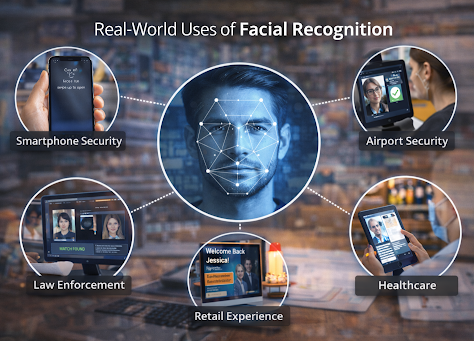
Smartphone Security and Device Access
One of the most common uses of facial recognition is unlocking smartphones and other personal devices. Instead of typing a password or PIN, users can simply look at their screen to gain access.
This method relies on advanced sensors and artificial intelligence to map facial features and compare them to stored data. Modern systems analyze depth, contours, and unique characteristics rather than just a flat image, making them more secure than basic photo-based recognition.
Beyond unlocking devices, facial recognition is also used to authorize payments, log into apps, and verify identity for sensitive actions. It offers both convenience and enhanced security, reducing reliance on easily forgotten passwords.
Airport Security and Border Control
Airports around the world have adopted facial recognition technology to streamline passenger verification. Travelers can now pass through checkpoints using biometric scans instead of repeatedly presenting passports and boarding passes.
The system matches a live image of a passenger’s face with stored data from official identification documents. This helps confirm identity quickly and reduce waiting times.
In addition to improving efficiency, facial recognition can assist security personnel by identifying individuals flagged in law enforcement databases. While privacy concerns remain a topic of discussion, the technology is increasingly used to enhance both speed and safety in air travel.
Law Enforcement and Public Safety
Law enforcement agencies use facial recognition to identify suspects, locate missing persons, and support criminal investigations. By comparing surveillance footage to existing databases, authorities can generate potential matches more quickly than traditional methods.
For example, if security cameras capture images related to a crime, investigators may use facial recognition tools to narrow down possible identities. The technology can also help find vulnerable individuals, such as missing children or elderly persons.
However, this application is also one of the most debated. Questions about accuracy, bias, and oversight continue to shape policies and regulations surrounding its use.
Retail and Personalized Customer Experiences
Facial recognition is gradually entering the retail environment. Some stores use the technology to enhance security by identifying known shoplifters. Others experiment with using it to personalize customer experiences.
For instance, digital signage may adjust content based on estimated age or gender. Loyalty programs can integrate facial recognition to identify returning customers and tailor promotions accordingly.
While these uses aim to improve efficiency and engagement, transparency is critical. Customers are more likely to accept the technology when businesses clearly explain how data is collected and used.
Healthcare and Patient Identification
In healthcare settings, accurate patient identification is essential. Facial recognition can help prevent medical errors by ensuring that records are matched to the correct individual.
Hospitals and clinics may use biometric verification to confirm patient identities during registration, reducing the risk of duplicate records or mix-ups. This is especially useful in emergency situations where patients may not have identification readily available.
Beyond identification, researchers are also exploring facial analysis tools that assist in diagnosing certain genetic conditions by recognizing characteristic facial features. While still evolving, these applications highlight the broader potential of facial recognition in medicine.
Balancing Innovation and Responsibility
Facial recognition technology is already embedded in daily life, often operating quietly in the background. Its benefits include faster authentication, improved security, and enhanced efficiency across industries.
At the same time, responsible use remains essential. Concerns about privacy, data storage, consent, and algorithmic bias require ongoing attention from governments, companies, and technology developers.
As facial recognition continues to evolve, its impact will depend not only on technical advancement but also on ethical implementation. When used thoughtfully and transparently, it has the potential to improve convenience and safety in meaningful ways.