6 Reasons Layoffs Happen in Profitable Companies
Lilla Odin
April 28, 2026
Imagine reading the quarterly report of a company announcing record profits, only to see headlines days later about hundreds of employees being laid off. It feels contradictory. If a company is making money, why cut jobs?
The assumption that profitability guarantees job security is common but often inaccurate. Companies operate within complex financial, strategic, and market-driven systems. Profit is only one piece of a much larger equation.
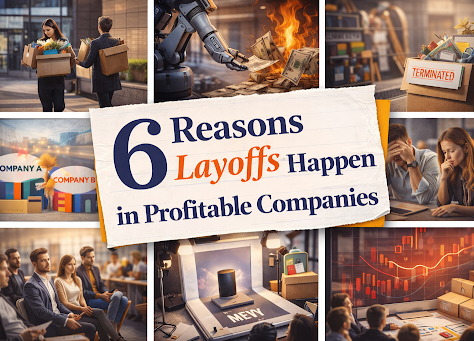
Below, we explore six key reasons layoffs happen even in profitable companies, and what they reveal about modern business strategy.
Key Takeaways
- Profitability does not always equal long-term stability.
- Companies prioritize future growth and shareholder expectations.
- Restructuring and cost optimization often drive layoffs.
- Technological shifts reduce the need for certain roles.
- Market uncertainty can trigger preventive workforce reductions.
- Strategic realignment frequently reshapes organizational structure.
1. Cost Optimization and Margin Protection
A company can be profitable and still seek to increase efficiency. Profit margins matter just as much as total revenue.
If executives believe expenses are rising too quickly or margins are tightening, they may reduce headcount to protect profitability. Labor is often one of the largest operational costs. Cutting roles can immediately improve financial ratios and investor confidence.
From a business perspective, this is seen as proactive management. From an employee perspective, it can feel abrupt and unfair.
2. Shifts in Business Strategy
Companies regularly change direction. They may exit certain markets, discontinue product lines, or pivot toward new technologies.
When strategy changes, roles aligned with previous priorities may no longer be necessary. For example, if a company shifts from physical retail expansion to digital-first operations, store management roles might decrease while tech roles increase.
Layoffs in profitable companies often reflect strategic realignment rather than financial distress.
3. Pressure from Shareholders and Investors
Publicly traded companies answer to shareholders who expect continuous growth. Even strong profits may not satisfy investors if growth slows compared to projections.
If earnings do not meet expectations, leadership may implement cost-cutting measures to maintain stock performance. Workforce reductions can signal decisive action to the market, sometimes boosting short-term investor confidence.
In this context, layoffs are sometimes driven more by financial optics and market positioning than by immediate necessity.
4. Automation and Technological Advancement
Technological innovation reshapes industries rapidly. Even profitable companies invest in automation, artificial intelligence, and process optimization to stay competitive.
As systems become more efficient, certain roles become redundant. Administrative, operational, or repetitive tasks may be replaced by software solutions.
These changes can improve productivity and reduce long-term costs, but they also lead to workforce reductions, even when revenue remains strong.
5. Mergers, Acquisitions, and Consolidations
When companies merge or acquire competitors, overlapping roles are common. Two marketing departments, two HR teams, or duplicate executive positions may not be necessary in the combined organization.
Even if both companies are profitable individually, consolidation aims to streamline operations and eliminate redundancies.
These layoffs are structural rather than financial, often framed as “synergy realization” in corporate communications.
6. Preparing for Economic Uncertainty
Profitable companies are not immune to economic shifts. Recessions, supply chain disruptions, regulatory changes, or geopolitical instability can threaten future performance.
In times of uncertainty, leadership may reduce headcount to build financial buffers. Preventive layoffs are often justified as a way to safeguard long-term stability.
While controversial, this approach reflects risk management rather than immediate financial crisis.
The Disconnect Between Profit and Job Security
Many employees equate company profitability with stability. However, profit is a snapshot in time. Businesses make decisions based on forecasts, competitive positioning, and long-term strategy.
Executives may focus on sustainability five or ten years ahead, while employees experience the impact in the present. This disconnect can create frustration and distrust, especially when layoffs follow positive earnings announcements.
Understanding the broader business context does not remove the human cost, but it clarifies the strategic logic behind such decisions.
What This Means for Employees
In today’s corporate landscape, job security depends on adaptability as much as company performance.
Employees can strengthen their resilience by:
- Continuously developing new skills aligned with industry trends
- Staying informed about company strategy and market direction
- Building professional networks beyond their current workplace
- Diversifying income streams when possible
Career stability increasingly depends on individual flexibility rather than organizational guarantees.
Conclusion
Layoffs in profitable companies may seem contradictory, but they often reflect strategic decisions rather than financial collapse. Cost optimization, investor pressure, technological change, restructuring, and risk management all play a role.
Profitability alone does not shield organizations from workforce reductions. Companies operate within competitive, fast-moving environments that demand constant adjustment.
While the business rationale may be strategic, the human impact remains significant. Recognizing the complexity behind these decisions can help professionals navigate uncertainty with greater awareness and preparedness.