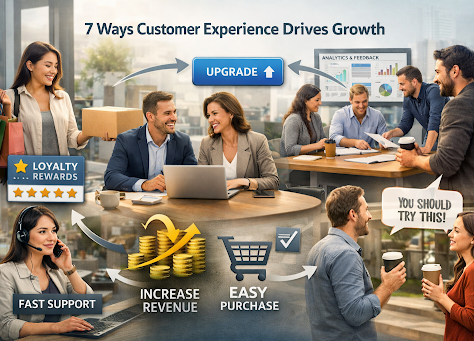
7 Ways Customer Experience Drives Growth
Lilla Odin
April 28, 2026
Customer experience is no longer a support function. It is a growth engine. In competitive markets where products are similar and switching costs are low, experience becomes the differentiator.
Growth can be simplified into three core drivers:
Revenue growth = Customer acquisition × Retention × Expansion
Customer experience directly influences all three variables. Companies that treat experience as a strategic priority often outperform those that focus only on marketing or pricing.
Below are seven ways customer experience drives measurable, sustainable growth.
Increasing retention and lifetime value
Retention is one of the most powerful growth levers. Acquiring new customers is typically more expensive than keeping existing ones.
If annual churn drops from 20 percent to 15 percent, lifetime value increases significantly. The effect compounds over time.
Customer experience improves retention through:
- Fast and effective support
- Clear onboarding
- Consistent communication
- Reliable product performance
When expectations match reality, customers stay longer. Longer retention increases lifetime value. Higher lifetime value allows companies to invest more in acquisition while maintaining profitability.
Retention is often the highest return investment in a growth strategy.
Improving conversion rates across the funnel
Customer experience begins before purchase. Website usability, response speed, clarity of messaging, and ease of checkout all influence conversion.
For example:
If 10,000 visitors convert at 2 percent, the result is 200 customers. If experience improvements increase conversion to 3 percent, the result is 300 customers.
That represents 50 percent growth without increasing traffic.
Reducing friction at key touchpoints such as sign up forms, pricing pages, and checkout flows often produces faster ROI than increasing advertising spend.
Experience optimization turns existing traffic into more revenue.
Driving referrals and organic acquisition
Satisfied customers recommend products. Dissatisfied customers warn others.
Positive customer experience increases:
- Word of mouth
- Online reviews
- Social media mentions
- Direct referrals
Referral driven growth has two advantages. Acquisition cost is lower, and trust is higher. A recommendation from a peer reduces decision hesitation.
When advocacy becomes consistent, growth accelerates organically. Customer experience effectively becomes a marketing channel.
Companies that track Net Promoter Score and referral rates often see a strong correlation between satisfaction and new customer acquisition.
Increasing average revenue per customer
Trust increases willingness to spend.
Customers who have positive experiences are more open to:
- Upgrades
- Cross sells
- Premium packages
- Longer term contracts
For example, if average revenue per customer increases from €100 to €120 due to successful upselling, revenue grows by 20 percent without adding new customers.
Good onboarding and proactive support increase product usage. Higher usage increases perceived value. Higher perceived value increases expansion revenue.
Customer experience does not only protect revenue. It expands it.
Reducing operational costs and inefficiencies
Poor experience creates hidden costs:
- Repeated support tickets
- Refunds
- Chargebacks
- Escalations
- Negative reviews requiring damage control
Clear documentation, intuitive product design, and efficient service processes reduce these friction points.
If support costs per customer decrease while revenue per customer increases, margins expand faster than topline growth.
Operational efficiency and customer satisfaction often reinforce each other. Simplified processes benefit both the company and the customer.
Strengthening brand equity and pricing power
Brand equity is built through consistent positive experiences.
When customers trust a company, they make faster decisions and show lower price sensitivity. Premium pricing becomes possible.
For example, two companies may offer similar products. The brand with stronger experience and trust can often charge 10 to 20 percent more without losing demand.
Over time, this pricing power increases margins and funds further innovation.
Experience builds credibility. Credibility builds long term competitive advantage.
Creating data driven feedback loops
Every customer interaction generates data.
- Usage behavior
- Support tickets
- Survey responses
- Churn patterns
- Conversion drop off points
Analyzing this data improves product development, marketing messaging, and operational processes.
For example, if onboarding drop off occurs at step three, redesigning that step can increase activation rates. Higher activation rates improve retention and revenue.
Customer experience systems create structured feedback loops. These loops enable continuous optimization.
Companies that measure experience rigorously make better decisions and allocate resources more effectively.
Turning experience into a growth system
Customer experience drives growth when it is treated as a system rather than a department.
Key metrics to monitor include:
- Customer lifetime value
- Churn rate
- Customer acquisition cost
- Net Promoter Score
- Average response time
Improvements should be prioritized based on impact and feasibility. Small friction reductions across multiple touchpoints often compound into significant revenue growth.
Customer experience is not a soft initiative. It is a measurable growth strategy.
When every interaction is designed intentionally, customers stay longer, spend more, and recommend more. That combination creates durable, repeatable growth.