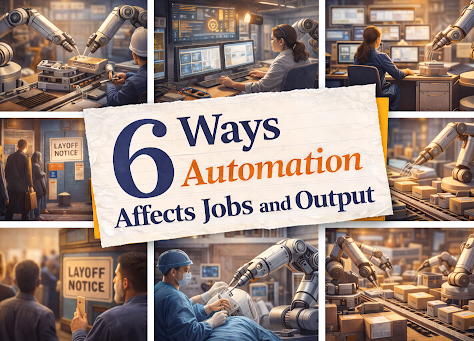
6 Ways Automation Affects Jobs and Output
Lilla Odin
April 28, 2026
Imagine walking into a factory where machines assemble products with near-perfect precision, or logging into software that completes tasks in seconds that once took hours. Automation is no longer a futuristic concept. It is embedded in manufacturing, healthcare, finance, marketing, logistics, and even creative industries.
As businesses adopt automation technologies such as artificial intelligence, robotics, and machine learning, both jobs and productivity are evolving. While some fear job displacement, others see unprecedented efficiency and innovation.
Below, we explore six major ways automation affects jobs and output, and what this transformation means for the future of work.
Key Takeaways
- Automation increases productivity and operational efficiency.
- Certain repetitive jobs are reduced or eliminated.
- New roles and industries emerge alongside automation.
- Workforces must adapt through reskilling and upskilling.
- Automation improves accuracy and reduces human error.
- Human creativity and strategic thinking remain essential.
1. Increased Productivity and Efficiency
One of the most significant benefits of automation is improved productivity.
Automated systems can operate continuously without fatigue, breaks, or errors caused by distraction. In manufacturing, robotics accelerates assembly lines. In digital industries, software automates data entry, customer responses, and reporting.
As a result, companies produce more output in less time. This increased efficiency often leads to higher profitability and faster service delivery.
However, greater output does not always mean more jobs. Efficiency gains sometimes reduce the need for certain roles.
2. Reduction of Repetitive and Manual Tasks
Automation primarily targets repetitive, rule-based tasks.
Jobs involving predictable physical labor or routine administrative work are most affected. For example, automated checkout systems reduce cashier demand, and AI-driven tools handle basic customer support inquiries.
While this shift can displace workers in certain sectors, it also eliminates monotonous tasks that many employees find draining. This creates space for more complex and creative responsibilities.
The challenge lies in managing transitions for workers whose roles are directly impacted.
3. Creation of New Job Opportunities
Despite concerns about job loss, automation also generates new employment opportunities.
As companies implement advanced systems, they require professionals to design, maintain, monitor, and improve these technologies. Roles in data analysis, cybersecurity, software development, robotics engineering, and AI ethics have grown significantly.
Additionally, entirely new industries emerge as technology evolves. Just as the internet created social media managers and app developers, automation continues to shape future career paths.
The labor market does not simply shrink. It transforms.
4. Demand for Reskilling and Upskilling
Automation accelerates the need for continuous learning.
Employees must adapt to new tools, systems, and workflows. Technical literacy, digital skills, and analytical thinking are increasingly valuable across industries.
Companies that invest in workforce training programs help employees transition into higher-skilled roles. Governments and educational institutions also play a role in supporting skill development.
In this new environment, adaptability becomes one of the most critical career advantages.
5. Improved Accuracy and Quality Control
Automated systems reduce the likelihood of human error, particularly in high-precision environments.
In healthcare, automation assists in diagnostics and data analysis. In logistics, algorithms optimize supply chains and reduce delays. In finance, software detects fraud patterns more effectively than manual review.
Higher accuracy improves product quality and customer satisfaction. Businesses benefit from fewer mistakes, reduced waste, and stronger reputations.
However, overreliance on automation without oversight can create new risks, especially if systems malfunction or are poorly programmed.
6. Redefinition of Human Roles
Automation does not eliminate the need for humans. It changes their focus.
As machines handle repetitive tasks, employees increasingly concentrate on strategic thinking, creativity, emotional intelligence, and decision-making. Skills such as leadership, collaboration, and problem-solving become more valuable.
In customer-facing roles, empathy and personalized service remain irreplaceable. In management, strategic planning and ethical judgment cannot be fully automated.
The future of work is likely to be collaborative rather than competitive between humans and machines.
Balancing Efficiency and Employment
The impact of automation depends on how organizations implement it.
Companies that prioritize responsible automation strategies consider both productivity and workforce well-being. Transparent communication, retraining programs, and gradual transitions can reduce disruption.
Policymakers also influence outcomes through education reforms, labor protections, and innovation incentives.
Automation is neither entirely positive nor entirely negative. Its effects depend on leadership decisions, economic policies, and societal adaptability.
Conclusion
Automation significantly affects jobs and output by increasing productivity, reducing repetitive work, creating new career paths, and redefining human roles. While some positions disappear, others evolve or emerge.
The key to navigating this shift lies in adaptability. Workers who embrace continuous learning and companies that invest in responsible implementation will benefit most.
Automation is not simply about replacing labor. It is about reshaping how work is done. In the right balance, it can enhance both economic growth and human potential.