5 Common Ways Passwords Get Compromised
Lilla Odin
April 28, 2026
Passwords are the keys to our digital lives. They protect our email accounts, social media profiles, online banking, work platforms, and personal files. Yet despite their importance, passwords are compromised every single day. Many people assume hackers rely on complex, movie-style techniques, but in reality, most password breaches happen through surprisingly common methods.
Understanding how passwords get compromised is the first step toward protecting yourself. Here are five of the most common ways your passwords can fall into the wrong hands.
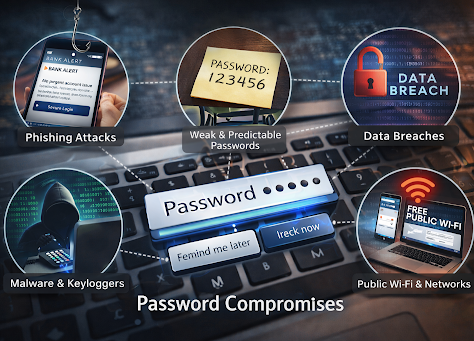
Phishing Attacks
Phishing is one of the most widespread and effective tactics used by cybercriminals. It involves tricking users into voluntarily giving away their login credentials.
A phishing attack often arrives as an email or text message that appears to come from a trusted source such as a bank, social media platform, delivery service, or even a colleague. The message usually creates urgency by claiming there is a problem with your account or that immediate action is required. You are then directed to click a link and log in.
The problem is that the link leads to a fake website designed to look identical to the real one. When you enter your username and password, the information goes directly to the attacker.
Phishing works not because of technical brilliance but because it exploits human psychology. Awareness, careful attention to website URLs, and avoiding suspicious links are critical defenses.
Weak and Predictable Passwords
Many password breaches occur simply because users choose weak or easily guessable passwords. Common examples include “123456,” “password,” birthdays, pet names, or simple keyboard patterns.
Hackers use automated tools that can attempt millions of password combinations in seconds. These tools rely on databases of commonly used passwords and predictable patterns. If your password is short or simple, it can be cracked quickly through brute force attacks.
Using long, complex passwords that combine uppercase letters, lowercase letters, numbers, and special characters significantly reduces this risk. Even better, passphrases made of random words can offer strong protection while remaining easier to remember.
Data Breaches from Other Websites
Sometimes your password is compromised even if you did nothing wrong. When companies experience data breaches, attackers may gain access to large databases containing usernames and passwords.
If you reuse the same password across multiple platforms, a breach on one website can put all your other accounts at risk. Hackers often test stolen credentials on popular services such as email, banking, and social media platforms in what is known as credential stuffing.
This is why password reuse is so dangerous. Even if one platform has weak security, using unique passwords for each account limits the damage and prevents a chain reaction of compromised accounts.
Malware and Keyloggers
Malicious software can silently capture your passwords without you ever noticing. Keyloggers are a type of malware designed specifically to record every keystroke you make. If your device becomes infected, attackers can collect login credentials as you type them.
Malware can be installed through infected downloads, unsafe websites, suspicious email attachments, or compromised software. In some cases, simply clicking the wrong link can trigger a hidden installation.
Keeping your operating system and software updated, using reliable antivirus protection, and avoiding untrusted downloads can significantly reduce the risk of malware-based password theft.
Public Wi-Fi and Unsecured Networks
Public Wi-Fi networks in cafes, airports, and hotels are convenient but often insecure. If a network lacks proper encryption, attackers connected to the same network may intercept data transmitted between your device and websites.
In some cases, cybercriminals create fake Wi-Fi hotspots that mimic legitimate network names. When users connect, their data can be monitored or redirected.
Without encryption, login credentials can be exposed. Using secure websites with HTTPS encryption helps, but for added protection, a virtual private network can encrypt your traffic on public networks and reduce the risk of interception.
Protecting What Matters Most
Passwords remain one of the most common targets in cybercrime because they provide direct access to valuable information. Fortunately, most compromises happen through predictable and preventable methods.
Using strong and unique passwords, enabling two-factor authentication, staying alert to phishing attempts, keeping devices secure, and avoiding unsafe networks can dramatically improve your digital security.
In today’s interconnected world, protecting your passwords is not just about safeguarding accounts. It is about protecting your identity, your finances, and your privacy. Small habits make a significant difference, and the effort to stay secure is far less costly than the consequences of a compromised account.